


How one company cut healthcare costs and boosted enrollment with a new way to offer insurance
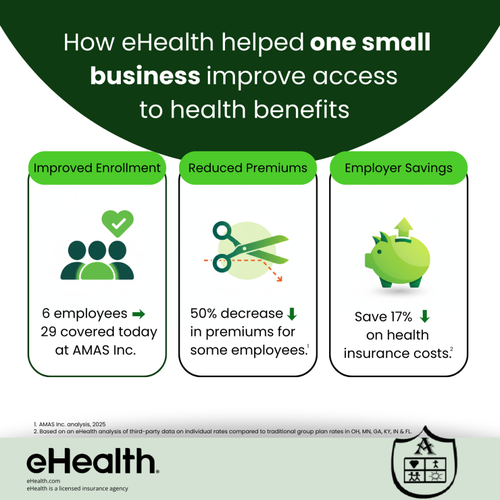
For Sheryll Bombard and the team at AMAS Incorporated, providing employees with health insurance has long been a priority. But between rising premiums and sluggish enrollment among employees, continuing to offer health benefits became nearly impossible.
“We were at a crossroads,” said Bombard, operations manager at the Minnesota-based provider of assisted-living services. “We needed a new solution, and fortunately eHealth provided that.”
That solution came in the form of Individual Coverage Health Reimbursement Arrangement (ICHRA), which for a growing number of companies is replacing the traditional group insurance model. Just as pensions gave way to 401(k) plans to help employees save for retirement, ICHRA is doing the same for employer-sponsored health benefits.
Tip: For help evaluating if ICHRA is right for your organization, click here to request a free quote and learn how Iris™ from eHealth can cap costs, simplify employee health insurance and save your company 17% or more on health insurance costs.[1]
As an alternative to the group health insurance, ICHRA (pronounced “ick-ra”) allows companies to make tax-deferred contributions toward the premiums of health plans employees select for themselves and their families in the open market. Like 401(k) plans, ICHRA moves employers from providing defined benefits to defined contributions, enabling employees to select from a broad range of insurance carriers and individual and family plans — rather than the one to three group plan options commonly offered by employers.
ICHRA is becoming an increasingly popular option for employers of all sizes, especially in states such as Minnesota where the cost of traditional group coverage can be significantly more expensive than individual coverage. In fact, the number of employees with this type of coverage increased 50% over the last year.
“Offering health benefits is a priority because we know how important that is for our colleagues,” said Bombard of AMAS, which operates 14 group homes across Minnesota for people with mental and physical disabilities. “Before ICHRA, many of our employees were disappointed with the limited number of options and the high out-of-pocket costs, so much so that most of our colleagues opted to go without health insurance.”
Under the traditional group insurance model, Bombard said just six employees enrolled in the available health plans. That number has now jumped to 29 after moving to ICHRA.
“Not only did enrollment surge dramatically, but some of our employees saved 50% or more compared to what they had been contributing out of their paychecks for health insurance,” said Bombard, who has worked at AMAS for more than seven years. “At the same time, the amount AMAS paid on a per employee basis declined dramatically. It was truly a win-win scenario for our employees and our organization.”
To use an ICHRA, employers usually select an administrator — typically a licensed health insurance agency such as eHealth — which will assist employees with enrollment and on-going support. Employees must enroll in a qualifying individual health insurance plan, which must meet federal minimum coverage standards to be eligible. In most cases, employees will be able to select from among a dozen or more ACA-compliant individual and family health insurance plans, with the insurance broker helping compare the options based on individual needs and preferences.
“Without ICHRA and eHealth, we wouldn’t have been able to continue to offer health benefits to our employees,” said Bombard. “We take great pride in providing outstanding support to the people we are privileged to serve, and that starts with a healthy and engaged workforce.”
For More Information: Click here to request a free quote and learn how Iris™ from eHealth can cap costs, simplify employee health insurance and save your company 17% or more on health insurance costs.
[1] Based on an eHealth analysis of third-party data on individual rates compared to traditional group plan rates in OH, MN, GA, KY, IN & FL.